
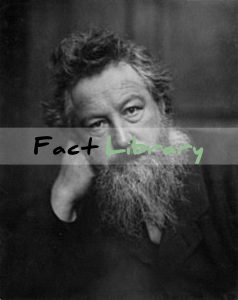
William Morris was born on March 24, 1834, in Walthamstow, Essex, England. He grew up in a wealthy middle-class family, and his childhood was shaped by nature and medieval architecture. He attended Marlborough College and later studied at Exeter College, Oxford, where he developed a strong interest in medieval literature, art, and architecture. At Oxford, he met Edward Burne-Jones and other artists who influenced his creative path.
After leaving university, Morris trained briefly in architecture under George Edmund Street. He soon turned to design and became involved with the Pre-Raphaelite Brotherhood. In 1861, he co-founded Morris, Marshall, Faulkner & Co., a decorative arts firm that produced furniture, textiles, and wallpapers. His designs promoted craftsmanship and rejected the mass production of the Industrial Revolution.
Morris became famous for his textile patterns and wallpapers, including works like “Strawberry Thief” and “Willow Bough.” His creations reflected his love for nature and medieval styles. He also wrote poetry, novels, and essays. His literary works included The Earthly Paradise and News from Nowhere, which combined storytelling with his vision of a better society.
In 1891, he founded the Kelmscott Press, which produced beautifully crafted books inspired by medieval manuscripts. The press became a symbol of the Arts and Crafts Movement, which Morris helped lead. His work influenced design, printing, and literature across Britain and beyond.
Morris was also active in politics. He became a socialist and spoke out against industrial capitalism. He believed in a society where art and labor were valued equally. His activism connected his artistic vision with his desire for social reform.
He married Jane Burden in 1859, and they had two daughters, Jenny and May. May Morris followed her father’s path and became a respected designer and embroidery artist. Family life and his home at Kelmscott Manor played an important role in his creative work.
William Morris achieved success through his designs, writings, and activism. His influence reached across art, literature, and politics. He worked mainly in London and Oxford but his ideas spread internationally. His wealth came partly from his family background and partly from his business ventures, but his true success was measured by the impact of his work.
He died on October 3, 1896, in London at the age of sixty-two. His legacy lives on in the Arts and Crafts Movement, in his designs that are still admired today, and in his writings that continue to inspire. William Morris remains one of the most important cultural figures of Victorian Britain, remembered for his creativity, vision, and dedication to both art and society.
William Morris Academic Foundations and Intellectual Development
Before rising to prominence, William Morris underwent a rigorous and influential education that shaped his medievalist worldview. He attended Marlborough College, where he spent much of his time exploring the nearby countryside and local historic architecture rather than focusing strictly on a traditional curriculum. In 1853, he moved to Exeter College, Oxford, with the initial intention of entering the clergy. While at Oxford, he encountered the writings of John Ruskin, which deeply affected his philosophy on art and labor. It was also here that he met Edward Burne-Jones, forming a lifelong friendship that would define much of his creative life. Together, they joined a group of like-minded students known as “The Set” or “The Brotherhood,” dedicated to medieval chivalry and social reform. These university years shifted his focus from the church to the arts. He developed a profound passion for Icelandic sagas and Gothic architecture, providing the intellectual bedrock for his future design work and socialist activism.
William Morris Formative Business Ventures and Artistic Initiation
The professional journey of William Morris began with a brief apprenticeship in architecture under George Edmund Street. However, he quickly realized his talents lay in decorative arts and painting. In 1861, he co-founded the decorative arts firm Morris, Marshall, Faulkner & Co. along with several Pre-Raphaelite associates. This venture, often referred to as “The Firm,” aimed to revitalize traditional craftsmanship in an era dominated by industrial mass production. Morris was hands-on in every aspect, teaching himself the technical skills of woodblock printing, weaving, and dyeing. His early work involved stained glass and mural painting, notably contributing to the Oxford Union Debating Hall. This period was crucial for establishing his reputation as a designer who prioritized the beauty of natural forms and the dignity of manual labor. His collaborative spirit and dedication to high-quality materials transformed the domestic aesthetic of Victorian Britain, setting the stage for the wider recognition of his unique design philosophy.
William Morris Leadership and Influence in Design Movements
As his career progressed, William Morris became the primary figurehead of the Arts and Crafts Movement. His designs for wallpaper and textiles, characterized by intricate and flowing natural patterns, gained immense popularity among the middle classes. In 1875, he assumed total control of his business, renaming it Morris & Co. This move allowed him to implement his vision of “art for all” more effectively, though the high cost of hand-craftsmanship meant his products remained largely for the wealthy. He campaigned against the dehumanizing effects of the Industrial Revolution, advocating for a society where workers could find joy in their labor. His home, Red House in Kent, became a physical manifestation of his design principles, featuring collaborative work from his artistic inner circle. His influence extended to interior decoration, furniture, and stained glass, permanently altering how art was integrated into everyday living spaces. He successfully demonstrated that functional objects could be both beautiful and socially responsible.
William Morris Literary Contributions and Socialist Political Reform
Beyond his visual art, William Morris was a prolific writer and a committed revolutionary socialist. He authored epic poems like The Earthly Paradise and the utopian novel News from Nowhere, which imagined a future society without private property or industrial pollution. His literary work often drew on his love for Norse mythology and medieval legends. In the 1880s, his growing concern over social inequality led him to join the Social Democratic Federation and later found the Socialist League. He spent much of his time lecturing on street corners and writing for political journals like Commonweal. For Morris, art and politics were inseparable; he believed that true art could only flourish in a society where everyone was free from exploitation. His translations of Icelandic sagas introduced English readers to new literary traditions, while his political essays provided a powerful critique of Victorian capitalism. He remained a tireless activist until his final years, balancing his demanding business responsibilities with his commitment to social change.
William Morris Domestic Life and Family Legacy
The personal life of William Morris was centered around his marriage to Jane Burden, whom he met in 1857 while she was modeling for the Pre-Raphaelite painters. They married in 1859 and eventually moved to Kelmscott Manor, a rural retreat that Morris deeply loved. Together they had two daughters, Jenny and May Morris. While his marriage was often complicated by Jane’s long-term romantic relationship with Dante Gabriel Rossetti, Morris remained a devoted father. His younger daughter, May, followed closely in his footsteps, becoming a distinguished designer and embroidery artist in her own right. She took over the embroidery department of Morris & Co. and worked tirelessly to preserve her father’s legacy after his passing. The Morris household was often a hub of artistic and political discussion, filled with the leading thinkers and creators of the day. His family life was deeply intertwined with his professional work, as both his wife and daughters contributed to the production and promotion of the iconic Morris & Co. brand.
William Morris Financial Management and Economic Success
Throughout his life, William Morris was supported by a combination of significant family inheritance and his own successful business ventures. His father, a wealthy financier and mining investor, left him a substantial fortune that provided him with an annual income of roughly nine hundred pounds upon reaching adulthood. This financial security allowed him to pursue art and politics without the immediate pressure of earning a living. However, Morris was also an astute businessman who successfully managed Morris & Co. for decades. While his commitment to expensive hand-craftsmanship often limited his profit margins, the firm became highly fashionable and financially viable. He reinvested much of his wealth into his creative projects, such as the Kelmscott Press, which produced high-end, beautifully printed books. His success was not measured solely in monetary gain but in the cultural capital and influence he built. He maintained a comfortable lifestyle at Kelmscott House and Kelmscott Manor, using his resources to fund socialist causes and artistic experimentation.
William Morris Enduring Cultural Legacy and Future Influence
The impact of William Morris on the modern world is vast, spanning the fields of design, literature, and political thought. He is remembered as a pioneer of modern environmentalism and a visionary who foresaw the need for sustainable and meaningful work. His wallpaper and textile patterns remain in continuous production today, testifying to the timeless appeal of his aesthetic. The Kelmscott Press, founded in his final years, sparked a revival in fine book printing and graphic design. In the literary world, his fantasy romances laid the groundwork for authors like J.R.R. Tolkien and C.S. Lewis. His socialist ideals continue to inspire movements advocating for labor rights and the preservation of traditional crafts. Museums and galleries around the world, including the William Morris Gallery in London, are dedicated to his work. His legacy serves as a constant reminder that beauty and utility should be accessible to all, and that the natural world is a vital source of creative inspiration.
William Morris Childhood Foundations and Early Life in Essex
William Morris was born into a wealthy middle-class family in Walthamstow, Essex, and spent his early years in the affluent surroundings of Woodford Hall. His childhood was deeply influenced by the nearby Epping Forest, where he spent hours exploring the woods and developing a lifelong love for nature. This connection to the landscape is evident in nearly all of his later designs. He was a precocious reader, finishing all of Walter Scott’s novels before the age of seven. His father’s success as a broker ensured a privileged upbringing, providing young William with access to the finest education and resources. Growing up in a house filled with traditional Victorian values, he nevertheless felt a strong pull toward the medieval past, a fascination sparked by visits to local churches and historic sites. These formative experiences in the Essex countryside established the primary themes of his life: a reverence for the natural world and a deep respect for the architectural heritage of the past.
William Morris Age (Reflecting the Temporal Scope of His Life and Times)
William Morris was born on March 24, 1834. He lived to the age of 62. The final William Morris age recorded at his death on October 3, 1896, was 62 years. These dates and figures represent the factual chronological data for the individual.
William Morris Wife (A Glimpse Into His Primary Personal Partnership)
Jane Burden was the wife of William Morris. The marriage took place on April 26, 1859. She remained married to him until his death in 1896. This individual is the only woman to hold the status of his legal spouse.
William Morris Cause of Death (Analyzing the Final Chapter of His Vital Journey)
William Morris died from tuberculosis. This medical condition was the primary cause of his passing on October 3, 1896. His physician also famously attributed his death to the exhaustion of performing the work of ten men. He was 62 years old at the time of his decease.
William Morris Artwork (Exploring the Aesthetic Reach of His Creative Production)
William Morris produced “Strawberry Thief” and “Willow Bough” as prominent textile designs. His artistic output includes the painting “La Belle Iseult” and various stained glass windows. He created detailed wallpaper patterns such as “Trellis” and “Chrysanthemum.” The Kelmscott Press edition of “The Works of Geoffrey Chaucer” serves as a major example of his graphic and typographic artwork.
William Morris Profile Table (A Structured Overview of Key Historical and Personal Data)
| Profile | Information |
| William Morris career | Textile designer, poet, novelist, translator, and socialist activist |
| William Morris real name | William Morris |
| William Morris age | 62 years |
| William Morris date of birth | March 24, 1834 |
| William Morris net worth | Supported by significant family inheritance and business success (estimated annual income of £900 in adulthood) |
| William Morris wife / spouse | Jane Burden (m. 1859–1896) |
| William Morris children | Jane Alice “Jenny” Morris and Mary “May” Morris |
| William Morris parents | William Morris Sr. and Emma Shelton |
| William Morris religion | Atheist (raised Evangelical, later described himself as a “pagan”) |
| William Morris state of origin | Essex, England |
| William Morris alma mater | Exeter College, Oxford |
| William Morris education | Marlborough College and Exeter College, Oxford |
| William Morris nationality | British |